
This title is currently out of stock. Leave us your email address, we’d let you know when it’s in stock again!
-

A note on book covers: while we do our best to ensure the accuracy of cover images, ISBNs may at times be reused for different editions of the same title which may hence appear as a different cover.

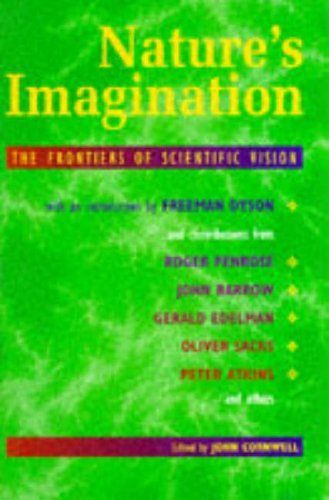
Nature's Imagination: The Frontiers of Scientific Vision
Nature's Imagination: The Frontiers of Scientific Vision
Couldn't load pickup availability
Nature's Imagination gathers together the work of thirteen leading mathematicians, astronomers, neuroscientists, and philosophers, as they discuss the revolution sweeping the sciences. Here Roger Penrose, Oliver Sacks, John Barrow, Gregory Chaitin, Margaret Boden, and others explore how and why classic reductionism is falling by the wayside in their own fields. As Freeman Dyson writes in the introduction, science is an art form, not a philosophical method, and it is always in search of new tools. Reductionism has done its work, and scientists are in search of another. Roger Penrose offers a fascinating account of irreducibility in mathematics, starting with the example of an impossible triangle--a drawing of a triangular object twisted so that could not exist in three dimensions. He breaks the triangle into three parts, showing that each corner is physically possible; only in combination is the triangle impossible. Both Penrose and mathematician Gregory Chaitin explore Godel's incompleteness theorem--as does John Barrow, who explains that Chaitin's proof of the theorem shows that, if we ever arrive at a Theory of Everything, there may be a still deeper and simpler unifying theory beyond that. Other contributors discuss the changing thinking in neuroscience, and the limitations of a mechanical view of the mind: as Oliver Sacks writes, if we are to have a model or theory of mind as this actually occurs in living creatures in the world, it may have to be radically different from anything like a computational one. In addition, this volume includes staunch defenders of the classic scientific approach, such as Peter Atkins (The omnicompetence of science, and in particular the simplicity its reductionist insight reveals, should be accepted as a working hypothesis until, if ever, it is proved inadequate).
The advance of science has been so startlingly swift in the last century that it has begun to approach limits never dreamed of before. This remarkable volume captures the latest thinking on where we must turn if we are to truly understand ourselves and the universe we live in.
Details of Book
Related Collections:
A note on book covers: while we do our best to ensure the accuracy of cover images, ISBNs may at times be reused for different editions of the same title which may hence appear as a different cover.
-
One Line Summary
Explores science's shift beyond reductionism for holistic understanding.
-
Who is this book for?
If you're curious about the future of scientific thinking beyond traditional boundaries, this book offers fascinating insights from renowned scientists. It dives into how our understanding of mind, universe, and mathematics is evolving, challenging old paradigms and embracing a more integrated view. It's a thought-provoking read for anyone interested in the frontiers of science and philosophy.